
/currency.svg)
/heart.svg)
/user.svg)
/cart.svg)
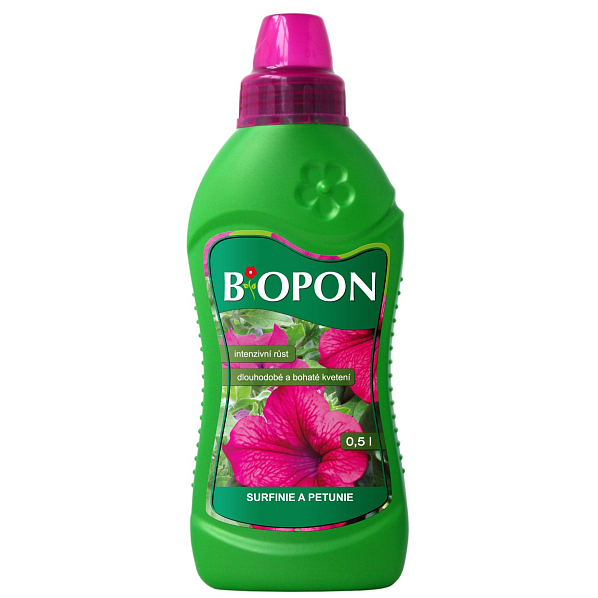
Bopon Surfinia and Petunia Liquid Multicomponent Mineral Fertilizer 500 ml
Product description Bopon Surfinia and Petunia Liquid Multicomponent Mineral Fertilizer 500 ml
| Manufacturer | Bros sp.j. Poland |
| Packaging | 6 |
- 1 cap of fertiliser per 1 l of water.
- Water the surfinias 3 times a week with this solution.
- Water or spray other flowering plants twice a week.
- Discontinue spraying during flowering and fertilise only by watering.
| Manufacturer | Bros sp.j. Poland |
| Packaging | 6 |
NPK solution 5.9+4.5+4.6 with trace nutrients. Nutrients: 5.9% nitrogen (N), 4.5% phosphorus oxide (P2O5), 4.6% potassium oxide (K2O), 0.01% boron (B), 0.002% copper (Cu), 0.02% iron (Fe), 0.01% manganese (Mn), 0.001% molybdenum (Mo), 0.002% zinc (Zn)
| Manufacturer | Bros sp.j. Poland |
| Packaging | 6 |
Petunias are generally pollinated by insects, with the exception of P. exserta, which is a rare, red-flowered species pollinated by hummingbirds. Most petunias are diploid with 14 chromosomes and interferes with other petunia species as well as Calibrachoa.
The tubular flowers are favored by some Lepidoptera species, including the hummingbird moth. The flowers are eaten by the larvae of the ear corn borer, Helicoverpa zea, and the cabbage looper, Trichoplusia ni
Petunias can tolerate relatively harsh conditions and hot climates, but not freezing. They need at least five hours of sunlight each day and thrive in moist soil and low atmospheric humidity conditions. They are best grown from seed. Watering once a week should be sufficient in most regions. Hanging baskets and other containers require more frequent watering. Maximum growth occurs in late spring. Daily or weekly applications of fertilizer, depending on the variety, will help the plant grow quickly.
In horticulture, many terms are used to refer to the different types of petunias grown. These include Grandiflora, Multiflora, Wave (spreading), Supertunia, Cascadia and Surfinia.
Keep locked up and out of reach of children. If ingested, seek medical attention immediately and show this container or label. Use biocides in a safe manner. Always read the label and product information before use.
Products similar to Bopon Surfinia and Petunia Liquid Multicomponent Mineral Fertilizer 500 ml you can also find in the following categories:
Recently visited products

Bopon Surfinia and Petunia Liquid Multicomponent Mineral Fertilizer 500 ml

Loreal Paris Color Riche Creme lipstick 328 Brillant de Rose Natural 4.5 g

Versace pour Homme eau de toilette 100 ml + eau de toilette 10 ml + cosmetic bag, gift set for men

Angel Folding gift box with ribbon blue 25 x 25 x 14.5 cm 1 piece