/search_thin.svg)

/currency.svg)
/heart.svg)
/user.svg)
/cart.svg)

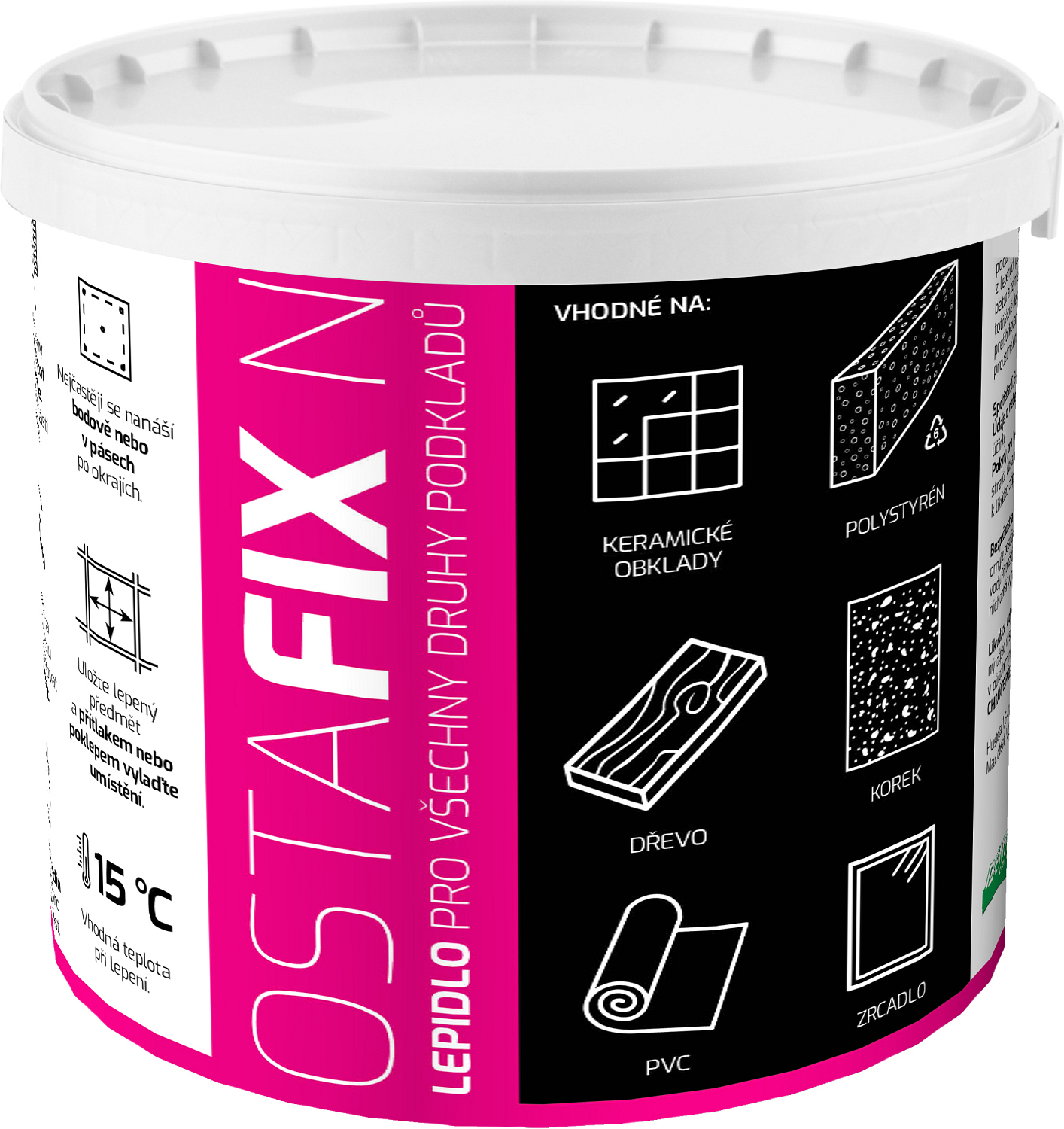
DENAS Ostafix N adhesive for all types of substrates, 1.2 kg
Code: 2503119In stock
Date and method of delivery
Producer:
Denas Color

Dispersion thin-layer adhesive of pasty consistency. Used for bonding ceramic coverings and tiles, ceilings, cladding boards and moldings made of expanded polystyrene and polyurethane, wood, PVC and rubber floor coverings, gypsum castings, and claddings.Read more
Choose a discounted package
Quantity discounts
/envelope.svg)
Query
/bell.svg)
Watch
/share.svg)
Share
PARAMETERS
Description DENAS Ostafix N adhesive for all types of substrates, 1.2 kg
Universal thin-layer adhesive DENAS OSTAFIX N is characterized by high adhesion and is intended for bonding ceramic tiles and coverings, ceiling panels, cladding panels and moldings made of polyurethane and expanded polystyrene, wood, glass, mirrors, PVC, rubber flooring, and also for gypsum castings or cladding. To create a strong bond, at least one of the surfaces to be bonded must be made of a cohesive and absorbent material, such as concrete, plaster, aerated concrete, and especially construction boards such as drywall, particleboard, fiber-cement, and cement-bonded boards, and possibly also laminate (for example in prefabricated apartment cores) and other construction substrates. OSTAFIX N can also be used to seal cracks and joints in the surface before applying paint.
Properties of DENAS mounting adhesive:
- universal
- for bonding on absorbent and non-absorbent substrates
- with high adhesion
- suitable for securing ceramic tiles and coverings
- also used for filling cracks and joints in the substrate material before painting
- white color
Composition (general):
Adhesive based on aqueous acrylic dispersion, containing binders based on aqueous acrylic dispersion, fine fillers, pigments, dispersing agents, and modifying additives
Application procedure for DENAS mounting adhesive:
The substrate must be solid, dry, and free from dirt and grease. Absorbent substrates should be treated with the penetration agent DENAS DEEP PENETRATION. Before bonding to old plasters, it is necessary to remove layers of paint, then thoroughly dust off and apply a primer. Solid and non-absorbent substrates only need to be thoroughly cleaned and degreased. The surface does not need to be primed.
OSTAFIX N is applied to the substrate using a notched trowel with a tooth height of 3–7 mm. The tooth height is determined by the flatness of the substrate and the format of the cladding material, so that after placing the cladding into the adhesive layer and its subsequent removal, the imprint of the adhesive must be clearly visible on the entire back side of the bonded material. The adhesive should be applied over an area that can be covered with cladding material within 10 minutes. The cladding is placed into the adhesive layer and is set into the desired position with pressure or tapping. Ceramic tiles must not be wet before bonding! In the case of bonding polystyrene ceiling tiles and coverings, full-surface bonding is not necessary; the adhesive is typically applied pointwise or in strips along the edges and in the center of the cladding boards. The temperature during bonding and drying of the adhesive must not drop below 15 °C.
Consumption: 0.3–1.5 kg/m2 depending on the type and quality of the substrate and the bonded materials.
Hazard information for DENAS mounting adhesive:
Safety handling instructions:
Prevent release into the environment. Dispose of contents/packaging by handing it to an authorized person for waste disposal or returning it to the supplier. H412 – Harmful to aquatic organisms, with long-term effects.
Safety and hygiene:
Follow personal hygiene principles. If skin contact occurs, wash the affected area with water and soap. In case of eye contact, rinse with water. If swallowed, rinse mouth with water, do not induce vomiting. If health problems occur, seek medical attention.
Waste disposal:
Dispose of leftover paints and contaminated packaging as hazardous waste in accordance with applicable regulations. The product maintains its utility properties in the original unopened packaging for at least the date indicated on the lid.
Density:
Density: 1.5–1.8 g/cm3; VOC: 0.0026 kg/kg; TOC: 0.0014 kg/kg; ONL: 70–80 % vol.; Maximum VOC content in the product in ready-to-use condition 0.0026 kg/kg.
| Species: | ostatní |
Documents
Bezpečnostní list
/document.svg)
Prohlášení o shodě
Katalogový list
Related products

Code:
2505428
6.43 EUR
22.96EUR/1l
In stock
/heart.svg) Favorite
Favorite/compare.svg) Compare
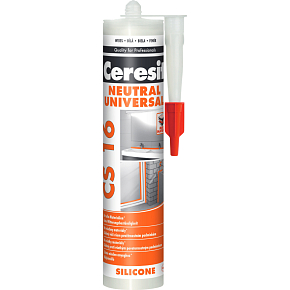
CompareSingle-component neutral alkoxy silicone sealant.

Code:
2503371
11.38 EUR
36.71EUR/1l
In stock
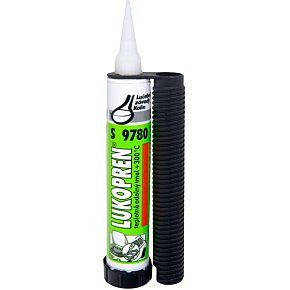
FavoriteCompareNeutral silicone sealant with temperature resistance of 250 °C (short-term up to 300 °C). Sealant for engineering, automotive repair, and construction. Low swelling in solvents and oils.

Code:
2504864
2.12 EUR
8.48EUR/1kg
In stock
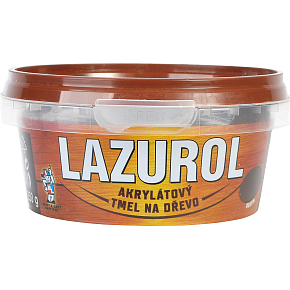
FavoriteCompareAcrylic paste-like putty for repairing cracks, grooves, and defects in wooden materials. Sandable, water-based putty designed for repairing cracks, grooves, and defects in wooden materials.
Code:
2506883
9.36 EUR
33.43EUR/1l
In stock
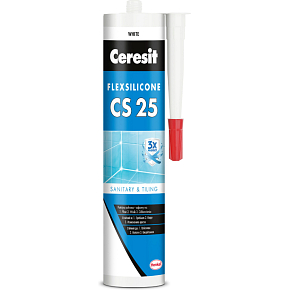
FavoriteCompareDesigned for filling expansion and connection joints between ceramic tiles and floors in corners or at the junction of walls and floors, and for the installation of sanitary fixtures in the sanitary area.

Code:
2506416
4.56 EUR
36.48EUR/1l
In stock
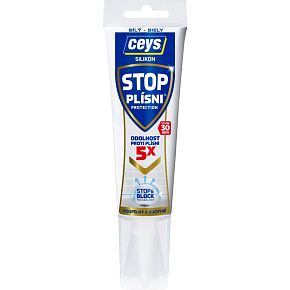
FavoriteCompareClean and white joints permanently. Top-quality silicone for bathrooms and kitchens, unique due to the combination of two unique properties.
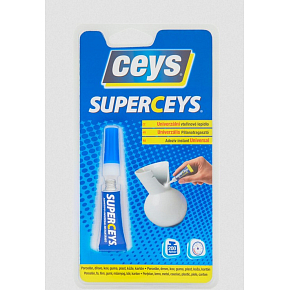
Ceys Super Ceys instant glue, 3 g
Code:
2601423
1.83 EUR
610EUR/1kg
In stock
FavoriteCompareCeys Super Ceys instant glue is a universal transparent glue for quick bonding of various materials. The bond forms in just a few seconds.

Code:
2506934
100%
7.95 EUR
28.39EUR/1l
In stock
FavoriteCompareCeys high temperature silicone is a black solvent-free acetate silicone specifically designed for high temperatures from -70°C to +250°C, with a limit up to +300°C. It is highly chemically resistant and permanently flexible.

Code:
2502924
4.42 EUR
55.25EUR/1l
In stock
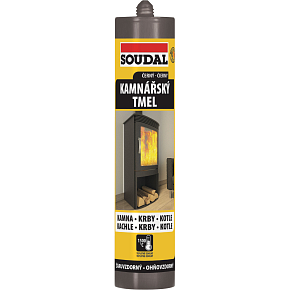
FavoriteCompareWithstands high temperatures up to 1500 °C. Contains no solvents or asbestos. Fully curing sealant for joints and sealing areas exposed to very high temperatures.

Code:
2507611
6.93 EUR
12.6EUR/1kg
In stock
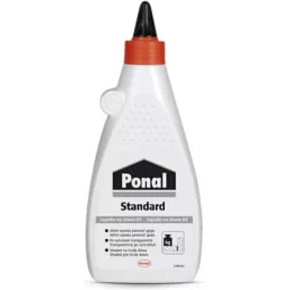
FavoriteComparePONAL Standard is a universal wood adhesive, including for hardwood.
Code:
2505663
5.37 EUR
19.18EUR/1l
In stock
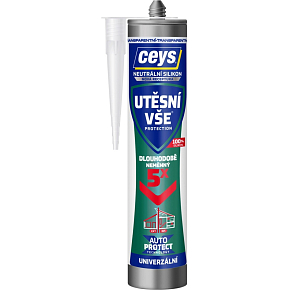
FavoriteCompareA high-quality and durable neutral transparent silicone that seals all types of materials including construction materials for both interior and exterior within 2 hours.

Code:
2507567
7.60 EUR
0.3EUR/1m
In stock
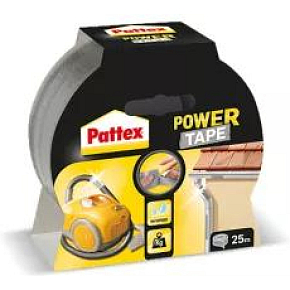
FavoriteComparePATTEX Power Tape is a universal fabric-reinforced adhesive tape for 1000 and 1 uses at home, work, during sports, and while traveling. It is suitable for indoor and outdoor use.


Code:
2504451
2.65 EUR
106EUR/1l
In stock
FavoriteCompareModern single-component adhesive based on MS polymer with immediate fixation and exceptionally high initial adhesion of up to 500 kg/m2.
Variants of this product

Code:
2505477
13.18 EUR
18.83EUR/1kg
In stock
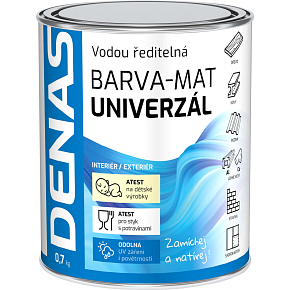
FavoriteCompareMatte universal water-based topcoat for metal, wood, concrete, galvanized steel, copper, and plasterboard.
Code:
2506477
30.56 EUR
61.12EUR/1kg
In stock
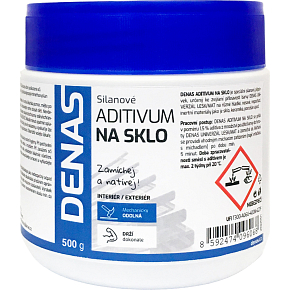
FavoriteCompareTo increase the adhesion of DENAS UNIVERZÁL paint to various smooth, non-absorbent, non-walkable, inert materials such as glass, ceramics, porcelain, etc. for both interior and exterior application.
Code:
2503983
11.38 EUR
16.26EUR/1kg
In stock
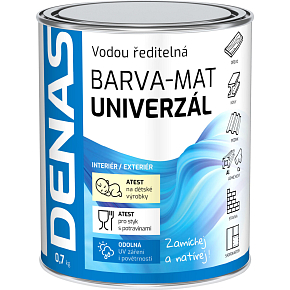
FavoriteCompareMatte universal water-based top coat for metal, wood, concrete, galvanized steel, copper, and drywall.
Code:
2503999
10.56 EUR
15.09EUR/1kg
In stock
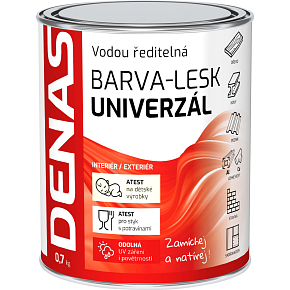
FavoriteCompareGlossy universal water-based top coat for metal, wood, concrete, galvanized iron, copper, and gypsum board. The most common applications are for doors, frames, railings, cladding, garden furniture, metal roofs, etc.
Code:
2504087
49.08 EUR
9.82EUR/1kg
In stock
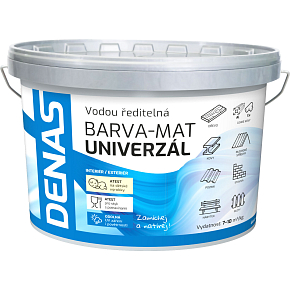
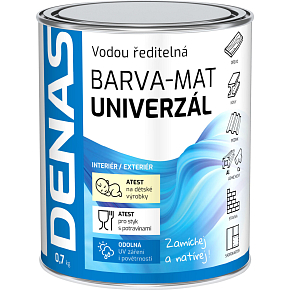
FavoriteCompareMatte universal water-based top coat for metal, wood, concrete, galvanized, copper, and drywall.
Code:
2503991
11.38 EUR
16.26EUR/1kg
In stock
FavoriteCompareMatte universal water-soluble top coat paint for metal, wood, concrete, galvanized surfaces, copper, and drywall.

Code:
2501979
19.86 EUR
7.94EUR/1kg
In stock
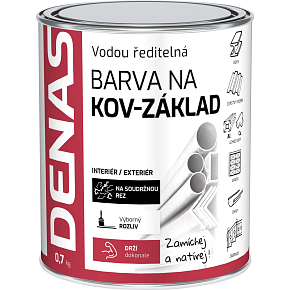
FavoriteCompareWater-dilutable walkable dispersion paint for concrete. Economically advantageous, washable 2-in-1 paint with a base.
Code:
2500299
8.20 EUR
11.71EUR/1kg
In stock
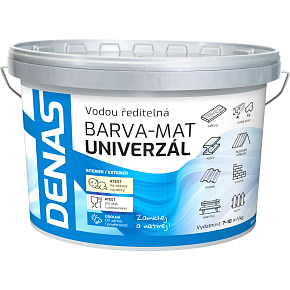
FavoriteCompareBasic anticorrosive protection for iron, aluminum, copper, galvanization on metal roofs and building structures. Water-based paint for metals for interior and exterior.
Code:
2507256
100%
49.08 EUR
9.82EUR/1kg
In stock
FavoriteCompareShade 0120 roof anthracite in a 5 kg package. Matte universal water-based top coat for metal, wood, concrete, galvanized steel, copper, and drywall.
Code:
2506456
9.50 EUR
13.57EUR/1kg
In stock
FavoriteCompareGlossy universal water-based top coat for metal, wood, concrete, galvanized metal, copper, and drywall. Most commonly used for finishing doors, door frames, railings, cladding, garden furniture, metal roofs, etc.
Code:
2506671
8.30 EUR
79.05EUR/1kg
In stock
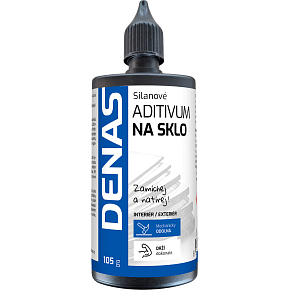
FavoriteCompareTo increase the adhesion of DENAS UNIVERZÁL paint on various smooth, non-absorbent, non-walkable, inert materials such as glass, ceramics, porcelain, etc., for application in interior and exterior.
Code:
2506438
5.69 EUR
18.97EUR/1kg
In stock
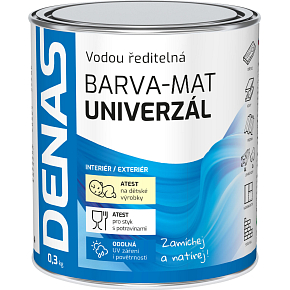
FavoriteCompareMatte universal water-dilutable top coat for metal, wood, concrete, galvanized, copper, and drywall.
Recently visited products